First principles thinking is often talked about in the context of Silicon Valley, tech founders, or elite problem-solvers. It can sound abstract, intimidating, or far removed from everyday life. But at its core, first principles thinking is simple: strip things down to what truly matters, and build your decisions from there—instead of blindly following habits, social expectations, or surface-level narratives.
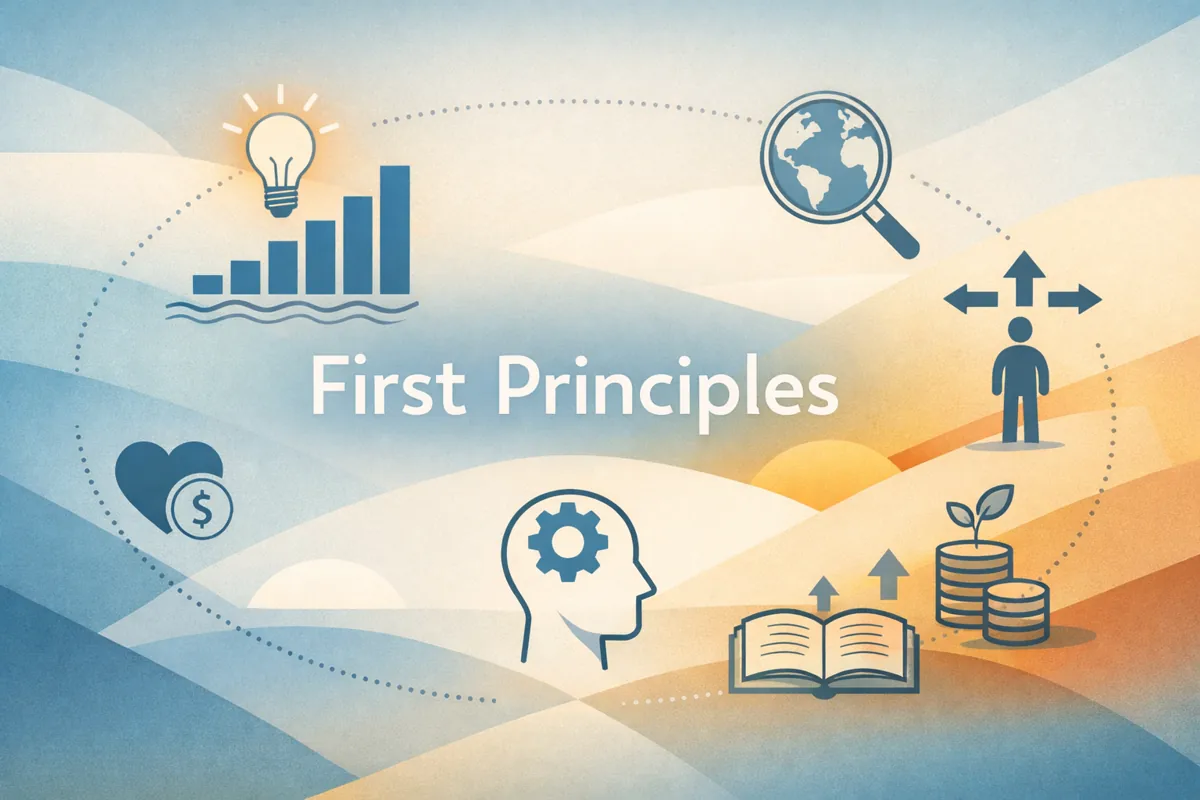
When applied to ordinary life, first principles thinking becomes less about brilliance and more about clarity. Below are several areas where this mindset can be especially useful.
1. Family: the first principle is economic stability, not emotion
Emotion matters, of course—but a family cannot function sustainably on feelings alone. At a fundamental level, economic stability is what allows care, patience, and long-term planning to exist. When financial foundations are weak, even strong relationships are put under constant strain. Love thrives best when survival is not the daily concern.
2. The workplace: the first principle is value exchange, not effort
Effort feels virtuous, but effort alone is not what organizations reward. What truly matters is the value you create and how clearly that value is recognized. Long hours and visible struggle don’t automatically translate into results. Understanding what the market, your employer, or your clients actually value—and aligning your work with that—is far more effective than simply trying harder.
3. Education: the first principle is independent thinking, not grades
Scores are measurements, not the purpose of learning. The deeper goal of education is to develop an independent mind—one that can question, analyze, and adapt. Without this, high grades often lead to fragile confidence and limited real-world capability. A person who can think for themselves will always outgrow someone who only knows how to perform on tests.
4. Health: the first principle is self-discipline, not medicine
Modern medicine is powerful, but it is largely reactive. Health, at its core, is built through daily habits: sleep, movement, diet, and emotional regulation. No treatment can consistently compensate for a lack of self-discipline. Prevention will always be cheaper, easier, and more effective than cure.
5. Entrepreneurship: the first principle is creating demand, not fighting over supply
Most failed businesses don’t lose because they worked too little—they lose because they entered crowded markets without solving a real problem. Entrepreneurship begins with understanding unmet needs and creating value where none previously existed. Competing in oversaturated spaces is usually a shortcut to exhaustion, not success.
6. Investing: the first principle is risk control, not high returns
High returns are attractive, but they are meaningless without survival. The first responsibility of any investor is not to make money, but to avoid losing it permanently. Managing downside risk, preserving capital, and staying in the game long enough to benefit from compounding matters far more than chasing spectacular gains.
7. Aging: the first principle is early planning, not dependence on children
Relying on others—especially the next generation—is an unstable strategy. Demographics, economics, and lifestyles are changing too fast. True security in later life comes from preparation: financial planning, health maintenance, and social independence built decades in advance.
8. Personal growth: the first principle is reflection, not experience
Experience alone does not guarantee growth. Many people repeat the same year of their life over and over, just with different scenery. Growth comes from reflection—examining what happened, why it happened, and how you will respond differently next time. Without reflection, life becomes passive. With it, even small experiences compound into wisdom.
First principles thinking isn’t about rejecting emotion, tradition, or society. It’s about seeing clearly. When you understand what truly drives outcomes, you stop wasting energy on illusions and start making decisions that actually work.
A life without reflection drifts with the current. A life built on first principles chooses its direction.
Most of us are living on “autopilot,” following scripts written by people we’ve never met. But when you break life down to its first principles, you realize you have much more agency than you think.
Which of these “first principles” do you think is the hardest to actually live by? Let’s talk in the comments.
Further Reading: Breaking the Poverty Cycle: 6 Proven Steps to Shift from Scarcity Mindset to Wealth Mindset and Escape Debt