

HomeMindful MomentsHow Ordinary People Can...

How Ordinary People Can Use First Principles Thinking in Everyday Life

First principles thinking is often talked about in the context of Silicon Valley, tech founders, or elite problem-solvers. It can sound abstract, intimidating, or far removed from everyday life. But at its core, first principles thinking is simple: strip things down to what truly matters, and build your decisions from there—instead of blindly following habits, social expectations, or surface-level narratives.
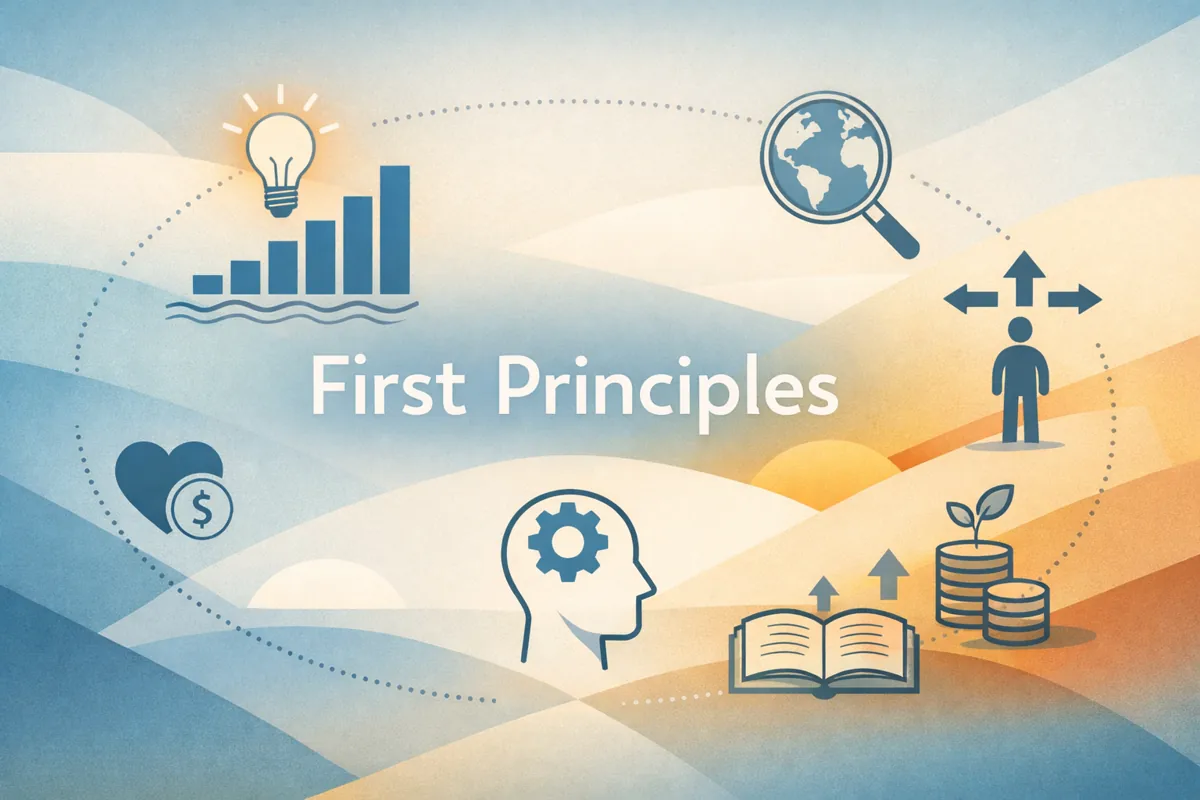
Minimalist abstract illustration representing First Principles thinking, with icons for growth, learning, decision-making, finance, and innovation.

When applied to ordinary life, first principles thinking becomes less about brilliance and more about clarity. Below are several areas where this mindset can be especially useful.

1. Family: the first principle is economic stability, not emotion

Emotion matters, of course—but a family cannot function sustainably on feelings alone. At a fundamental level, economic stability is what allows care, patience, and long-term planning to exist. When financial foundations are weak, even strong relationships are put under constant strain. Love thrives best when survival is not the daily concern.

2. The workplace: the first principle is value exchange, not effort

Effort feels virtuous, but effort alone is not what organizations reward. What truly matters is the value you create and how clearly that value is recognized. Long hours and visible struggle don’t automatically translate into results. Understanding what the market, your employer, or your clients actually value—and aligning your work with that—is far more effective than simply trying harder.

3. Education: the first principle is independent thinking, not grades

Scores are measurements, not the purpose of learning. The deeper goal of education is to develop an independent mind—one that can question, analyze, and adapt. Without this, high grades often lead to fragile confidence and limited real-world capability. A person who can think for themselves will always outgrow someone who only knows how to perform on tests.

4. Health: the first principle is self-discipline, not medicine

Modern medicine is powerful, but it is largely reactive. Health, at its core, is built through daily habits: sleep, movement, diet, and emotional regulation. No treatment can consistently compensate for a lack of self-discipline. Prevention will always be cheaper, easier, and more effective than cure.
5. Entrepreneurship: the first principle is creating demand, not fighting over supply

Most failed businesses don’t lose because they worked too little—they lose because they entered crowded markets without solving a real problem. Entrepreneurship begins with understanding unmet needs and creating value where none previously existed. Competing in oversaturated spaces is usually a shortcut to exhaustion, not success.

6. Investing: the first principle is risk control, not high returns

High returns are attractive, but they are meaningless without survival. The first responsibility of any investor is not to make money, but to avoid losing it permanently. Managing downside risk, preserving capital, and staying in the game long enough to benefit from compounding matters far more than chasing spectacular gains.

7. Aging: the first principle is early planning, not dependence on children

Relying on others—especially the next generation—is an unstable strategy. Demographics, economics, and lifestyles are changing too fast. True security in later life comes from preparation: financial planning, health maintenance, and social independence built decades in advance.

8. Personal growth: the first principle is reflection, not experience

Experience alone does not guarantee growth. Many people repeat the same year of their life over and over, just with different scenery. Growth comes from reflection—examining what happened, why it happened, and how you will respond differently next time. Without reflection, life becomes passive. With it, even small experiences compound into wisdom.

First principles thinking isn’t about rejecting emotion, tradition, or society. It’s about seeing clearly. When you understand what truly drives outcomes, you stop wasting energy on illusions and start making decisions that actually work.

A life without reflection drifts with the current. A life built on first principles chooses its direction.

Most of us are living on “autopilot,” following scripts written by people we’ve never met. But when you break life down to its first principles, you realize you have much more agency than you think.

Which of these “first principles” do you think is the hardest to actually live by? Let’s talk in the comments.

Further Reading: Breaking the Poverty Cycle: 6 Proven Steps to Shift from Scarcity Mindset to Wealth Mindset and Escape Debt


- Home of quirky finds -

 The Curiosity Shop

Most Popular

LEAVE A REPLY

Please enter your comment!
Please enter your name here

More from Author

The Inner Voice In Your Head: Where It Comes From And Why You Can’t Stop Thinking

At Soez World, we believe life should feel lighter—even when work...

How to Study Without Burning Out: A Sustainable Way to Stay Focused

Studying effectively isn’t about forcing yourself to work longer hours. It’s...

How to Increase Work Efficiency: A Complete Guide to Time Management for Everyone

In today's hustle-filled work world, boosting work efficiency isn't just for...

How to Clear Your Mind: 16 Simple Ways to Relieve Stress and Find Focus

In our hyper-connected world, if there is one thing that needs...

- A word from our sponsors -

Read Now

The Inner Voice In Your Head: Where It Comes From And Why You Can’t Stop Thinking

At Soez World, we believe life should feel lighter—even when work gets busy. But there’s one thing that often makes both life and work heavier than they need to be: the voice in your head. Have you ever wondered who that voice really is? Right now, as you read...

How to Study Without Burning Out: A Sustainable Way to Stay Focused

Studying effectively isn’t about forcing yourself to work longer hours. It’s about managing your energy, focus, and learning rhythm so you can stay consistent without exhausting yourself. Many people don’t struggle with learning ability. They struggle with study burnout, anxiety, and unrealistic expectations. I used to sit in...

How to Increase Work Efficiency: A Complete Guide to Time Management for Everyone

In today's hustle-filled work world, boosting work efficiency isn't just for CEOs or productivity gurus—it's a game-changer for everyday folks juggling deadlines, emails, and endless meetings. If you're wondering how ordinary people can improve work efficiency, you're in the right place. This guide dives deep into practical...

How to Clear Your Mind: 16 Simple Ways to Relieve Stress and Find Focus

In our hyper-connected world, if there is one thing that needs a seasonal deep clean, it’s our mind. We are constantly bombarded by 24-hour news cycles, work deadlines, social media pings, and the quiet hum of "what-ifs." This constant state of information overload creates mental clutter that...

Decoding the Machine: 50 Unconventional Tactics to Make AI Your Ultimate Partner

These clever tricks below, if used reasonably, can not only help you make the most of AI's value but also truly sharpen your own brainpower through AI, effectively avoiding the risk of your mind getting dull from over-relying on it. All 50 of these come straight from...

Stress-Busting Hacks: Three Quick Moves to Turn You into a Chill Master

Hey folks, ever had one of those "stress overload" moments where your heart's pounding like it's in a drum solo, your brain's a bubbling pot of instant noodles, and your mood's a wild horse ready to buck you straight into "regret canyon"? Guilty as charged! Last Friday,...

Breaking the Poverty Cycle: 6 Proven Steps to Shift from Scarcity Mindset to Wealth Mindset and Escape Debt

Did you know? Poverty isn't just an empty wallet—it's a vicious cycle that attracts more scarcity. A Harvard study shows that cultivating a wealth mindset can boost debt recovery success by up to 30%. I'm living proof: In 2023, I was drowning in over $150,000 of debt,...

The Diderot Effect: Beat the “Matching Trap” and Finally Embrace a Painless Minimalist Life

Hey everyone, I'm ThusZen, a regular person passionate about minimalism and constantly reflecting on my spending habits. Today, we're diving into a sneaky phenomenon that's quietly fueling overconsumption in modern life: the Diderot Effect (also known as the matching effect or Diderot unity). It's like an invisible...

7 AI Tools That Truly Lighten Your Workload:Give Your Time Back to Creativity

Stop using “being busy” to cover up inefficiency. Real productivity means letting AI handle repetitive tasks so you can focus on creating value. Have you ever experienced this? You sit at your desk, staring at a screen full of to-dos, and your mind whispers only one thing: “There’s no way...

Declutter: Let Go of the Excess, Release Attachment, and Live with Ease

In today’s fast-paced world, we’re often surrounded by piles of belongings, scattered thoughts, and unnecessary consumption. It leaves us exhausted and overwhelmed. Japanese clutter-management expert Yamazaki Hideko experienced a moment of sudden clarity during a yoga retreat, which inspired her to bring the concept of “Danshari” into...

Declutter Your Home: Practical Tips and Habits

Many people view tidying and organizing as simply the work of a homemaker. In reality, the principles of organizing extend far beyond household chores. In our lives, they can be applied to relationships, work, personal growth, and virtually any other area where structure and efficiency matter. A home...

How Ordinary People Can Live Better: A Practical Guide to Minimalist Living and Financial Health

If you’re earning a low income, say around $3,000–$4,000 a month before taxes, and after paying rent, groceries, and basic bills there’s almost nothing left, you might feel like every month is just a grind with no real reward. You might wonder: what’s the point of all...